At the very start of the nuclear age, scientists created a chilling symbol to show how close humanity might be to wiping itself out. It’s called the Doomsday Clock. Nearly 80 years later, that warning has never felt more urgent.
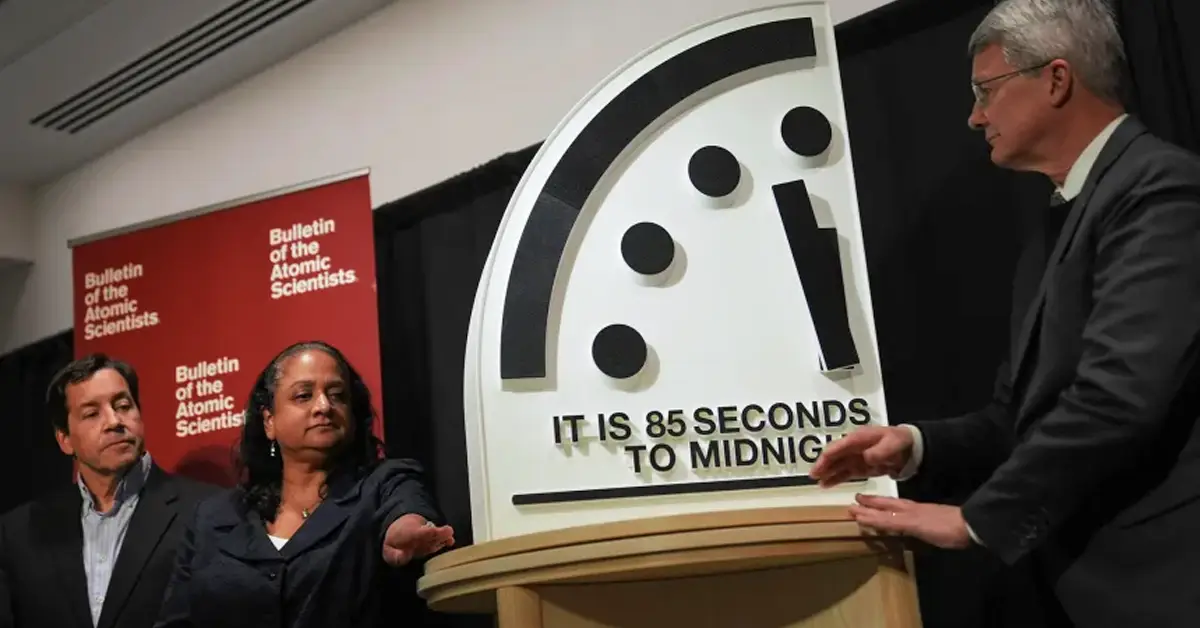
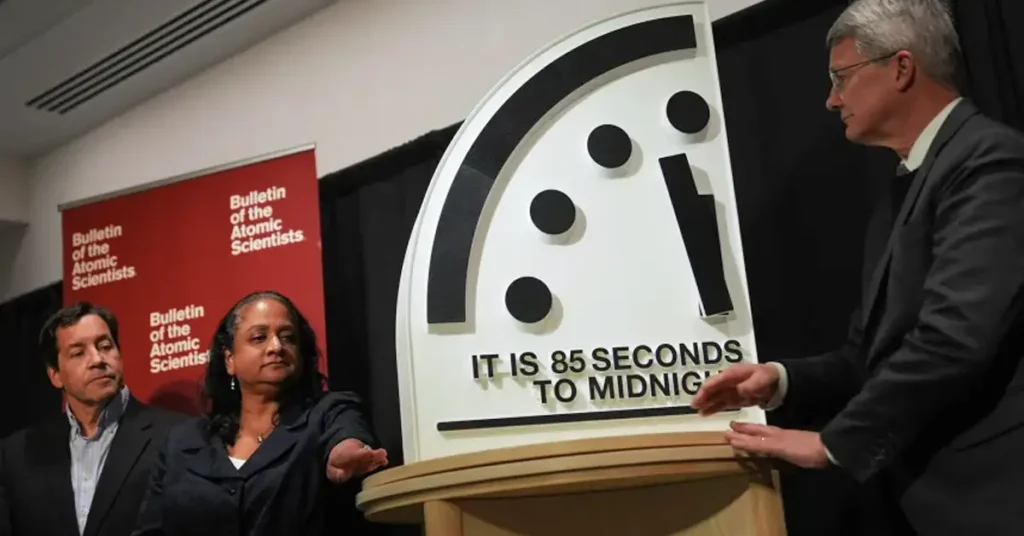
On Tuesday, scientists announced that the Doomsday Clock now stands at 85 seconds to midnight, the closest it has ever been. This update came from the Bulletin of the Atomic Scientists, the nonprofit organization that introduced the clock back in 1947.
Midnight on the clock represents the moment when human actions make Earth unlivable. According to experts, we are now closer to that moment than at any other point in history.
Why the clock moved closer this year
Last year, the clock was set at 89 seconds to midnight. Before that, it sat at 90 seconds in both 2023 and 2024. The latest shift reflects what scientists say is a lack of meaningful progress in tackling some of the biggest threats facing humanity.
These include nuclear risks, climate change, biological dangers, and fast-moving technologies like artificial intelligence. Scientists also pointed to the growing spread of misinformation, disinformation, and conspiracy theories as major dangers that make all other threats worse.
“Humanity has not made sufficient progress on the existential risks that endanger us all,” said Alexandra Bell, President and CEO of the Bulletin of the Atomic Scientists. She explained that the clock is meant to show how close people are to destroying the world using technologies they created themselves.
According to Bell, risks tied to nuclear weapons, climate change, and disruptive technologies are increasing, not shrinking. “Every second counts, and we are running out of time,” she said, calling the situation a hard but necessary truth to face.
Rising global tensions and nuclear concerns
Scientists warned last year that global leaders needed to shift toward cooperation to reduce existential risks. Instead, the opposite happened.
Dr. Daniel Holz, chair of the Bulletin’s science and security board, said major countries became more aggressive and nationalistic over the past year. Conflicts intensified in 2025, with several involving nations that possess nuclear weapons.
One of the biggest concerns is the possible expiration of the last remaining treaty that limits nuclear weapons stockpiles between the United States and Russia. That agreement is set to expire on February 4. If it does, there will be no formal limits on nuclear arsenals for the first time in more than 50 years.
Holz warned that this could open the door to an unchecked nuclear arms race, something the world has worked for decades to avoid.
Biological and technological risks are growing
Nuclear weapons are not the only danger pushing the clock closer to midnight.
Holz also highlighted serious threats in the life sciences, especially in emerging areas like synthetic mirror life. Despite repeated warnings from scientists around the world, there is no coordinated international plan to deal with these risks.
That leaves the global community unprepared for potentially devastating biological threats.
At the same time, the rapid expansion of artificial intelligence tools, combined with limited regulation, is making things worse. According to scientists, AI-driven misinformation and disinformation undermine efforts to address nuclear, climate, and biological risks.
In simple terms, unchecked technology is amplifying every other global threat.
What exactly is the Doomsday Clock?
The Bulletin of the Atomic Scientists was founded in 1945 by researchers who worked on the Manhattan Project, the effort to build the atomic bomb during World War II.
At first, the organization focused only on nuclear dangers. In 2007, it expanded the clock’s scope to include climate change as well.
Each year, experts adjust the clock based on how close they believe humanity is to a global catastrophe. Some years the time changes, and some years it stays the same.
The decision is made by the Bulletin’s science and security board, along with its board of sponsors. That board was originally formed by Albert Einstein, with J. Robert Oppenheimer serving as its first chair. Today, it includes eight Nobel Prize winners.
Is the clock meant to be taken literally?
The Doomsday Clock is not a precise scientific measurement. Instead, it’s designed to spark public discussion and draw attention to urgent global issues.
Some experts have questioned how useful the clock really is. Dr. Michael Mann, a climate scientist at the University of Pennsylvania, once described it as an “imperfect metaphor” because it combines different types of risks that unfold on different timelines.
Still, Mann and others agree that the clock remains a powerful reminder of how fragile our situation is.
Eryn MacDonald, a senior analyst at the Union of Concerned Scientists, has said the Bulletin makes careful decisions each year to capture public attention. While she wishes the world could go back to talking about minutes instead of seconds, she acknowledged that seconds now reflect reality.
What happens if the clock ever hits midnight?
The Doomsday Clock has never reached midnight, and scientists hope it never will.
Former Bulletin president Rachel Bronson explained that midnight would likely mean a nuclear exchange or catastrophic climate change severe enough to wipe out humanity. She added that people might not even realize when that moment arrives.
Can we still turn the clock back?
History shows that change is possible.
In 1991, the clock moved its farthest away from midnight, reaching 17 minutes to the hour. That shift followed the signing of the Strategic Arms Reduction Treaty between the United States and the Soviet Union.
Bronson believes that because humans created these threats, humans can also reduce them. But doing so requires serious effort, global cooperation, and sustained public engagement.
What can individuals do?
Scientists say people should not underestimate the power of conversation. Talking openly about these issues can help fight misinformation and pressure leaders to act responsibly.
Maria Ressa, CEO of the news outlet Rappler, summed it up clearly. Without facts, she said, there is no truth. Without truth, there is no trust. And without trust, collective action becomes impossible.
On a personal level, small lifestyle changes can also help, especially when it comes to climate risks. Walking instead of driving when possible, conserving energy at home, reducing food waste, using less plastic, recycling properly, and conserving water all make a difference.
Final thoughts
The Doomsday Clock is closer to midnight than ever before, but it is not a countdown set in stone. The warning is clear, but so is the message of possibility.
If you care about the future of the planet, now is the time to stay informed, talk about these issues, and push for meaningful action.
Stay aware. Share facts. Demand better decisions. The clock is ticking.